Abolish the BBC
Что дѣлать?

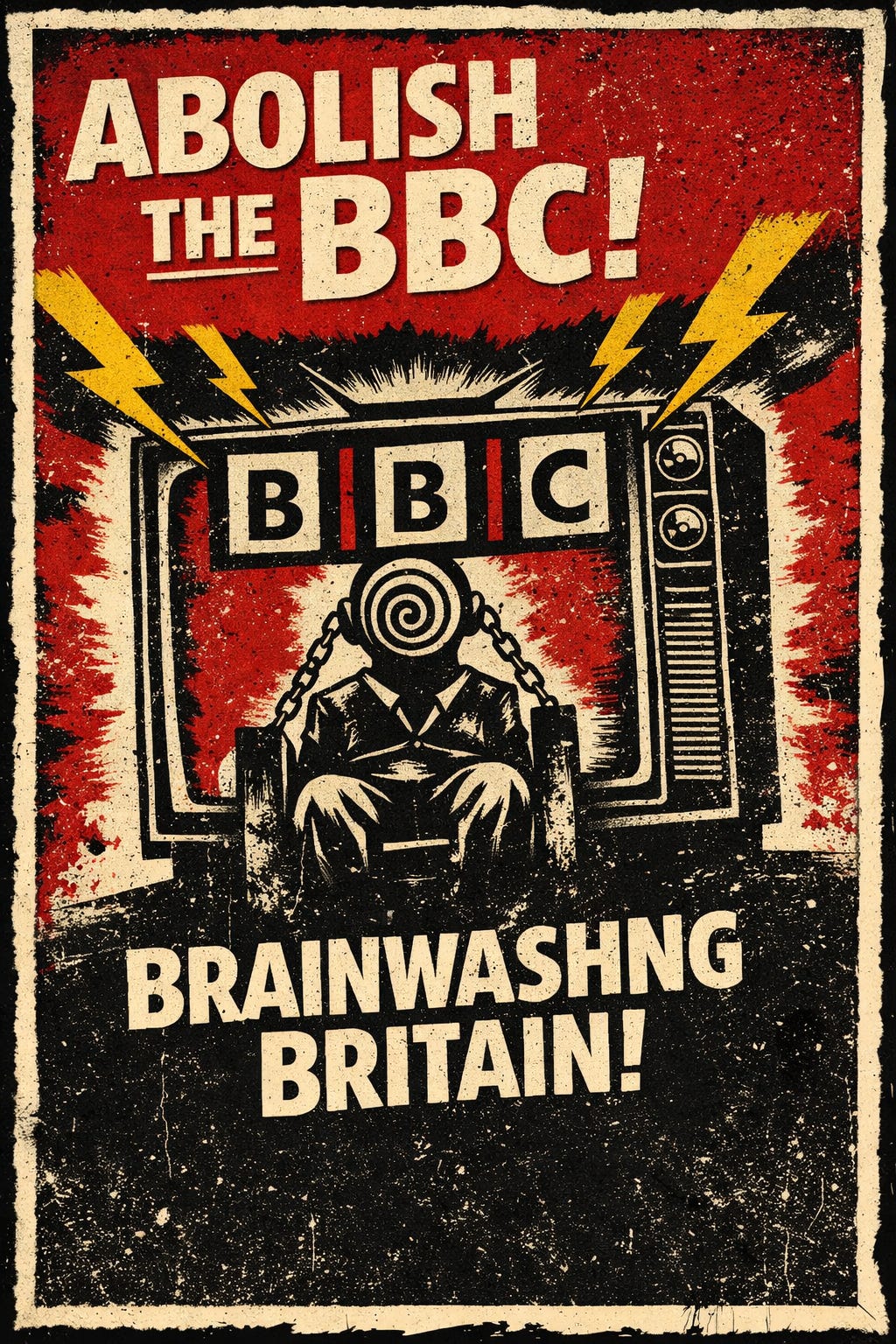
The BBC is, once again, the flavour of the week - and not for making the Ascent of Man for the 2020s.
This time it’s a dreary, undersaturated, take-itself-far-too-seriously spy drama The Capture, in which the obligatory far-right extremist plots to shoot migrants on a boat while muttering about government cover-ups. At one point, we’re told he uploads his videos via his “4chan account”, a line so technically illiterate it briefly snaps you out of the torpor. For the uninitiated, 4chan doesn’t have accounts. It’s an anonymous imageboard, deliberately primitive, almost pre–Web 2.0 by design.
Even as agitprop, it’s oddly incompetent. One might at least expect the full deluxe Britpopper paranoia package: a shadowy billionaire *ELON MUSK*, dark (PUTIN) algorithms nudging the masses toward extremism. But no. A drama ostensibly about online radicalisation can’t even be bothered to understand the platforms it’s gesturing at.
This has been emblematic of where the BBC has been for quite some time: the perpetrator of its own failure. Its cultural irrelevance is now such that you only really notice it when you switch it on — and are immediately reminded of the near-constant, low-grade, musty IdPol that fills the schedule. What remains feels oddly narrow: endless iterations of identikit panel shows, lifestyle programming, and cultural output (drag queens) pitched at an ageing, increasingly childless, geriatric millennial audience. In practice, thirty-eight-year-olds are about as young as the BBC’s linear viewer now gets.
Even its supposed tentpole moments feel like echoes. Comic Relief, once a genuine national ritual, now scrapes together a couple of million viewers, down from the five, even ten million it commanded within living memory. This is usually blamed on shrinking attention spans. But good programmes still draw audiences. This is like a chain restaurant that hasn’t updated its menu since the 1990s blaming Ozempic.
And instead of creating the next The Office or Only Fools and Horses, the BBC increasingly retreats into reheating its own back catalogue: Gavin & Stacey rolled out once more, increasingly Botoxed circuit comics and Mitchell and Webb brought out of retirement to dip into it’s cultural piggybank.
If you want to understand why the BBC debate never goes anywhere, read any establishment defence of it from the past forty years. They are all, in essence, the same article.
Take the latest iteration from Lionel Barber1: the BBC as a “victim of benign neglect” (i.e. Auntie has lost her way), in need of “bold leadership” and a “refreshed funding model”.
Let’s take its arguments in full below.
“These are seismic times for global media. In a matter of months, film producer David Ellison has seized control of CBS News, CNN and a slice of TikTok in the US. Amazon, Google and Microsoft are meanwhile spending billions of dollars on data centres to power the AI revolution. A new age of disruption is upon us.”
The purpose of this opening gambit is to suggest that “Auntie” is somehow vulnerable: besieged by disruption, menaced by shadowy billionaires hoovering up chunks of the global media landscape, threatened by forces beyond her control. In that sense, it is revealing. It shows how BBC loyalists increasingly see not just the corporation, but the wider establishment, as under siege.
But this gets causality exactly backwards. The BBC is not especially exposed to this disruption. It is unusually insulated from it. It is a publicly backed domestic broadcaster with guaranteed privileges, a protected charter, and a compulsory funding stream. If anything, that immunity is the problem.
Market pressure forces private firms to adapt or die. The BBC, by contrast, can keep churning out the same tired, by-numbers woke slop because the money keeps arriving anyway. Barber presents the corporation as vulnerable to modernity. In reality, its semi-protected status is precisely what allows it to remain so stale, complacent, and of course, resistant to genuine change.
“Hostile actors led by Russia, China and Maga ideologues are spreading disinformation…”
Se branler dans la piscine
“Yet the BBC… is still having to justify its existence…”
Well yes. The BBC is funded by a levy enforced with the threat of a criminal record, policed in practice by outsourced firms sending menacing letters to old and vulnerable people, while simultaneously claiming a quasi-sacred role as the nation’s broadcaster. An institution with coercive funding, constitutional privilege, and vast cultural influence does not get to treat public scrutiny as an imposition. It is the broadcast arm of the British state; it should have to justify itself constantly.
“The most pressing issue is a sustainable financing model.”
“One means to secure funding would be a German-style household levy.”
What does this mean in practice, especially in the case of the telly tax? It is only a “pressing issue” if you already believe that the public should, on pain of prosecution, be forced to pay for public service broadcasting. The BBC can stand on its own two feet, or it cannot. If it can, let it compete. If it cannot, then its defenders should stop hiding behind euphemisms about “sustainable financing” - a German-style household levy would simply rename the licence fee and broaden the tax base —-and state plainly why the public should be compelled, on pain of prosecution, to bankroll it.
“The Labour government could raise a tidy sum by hiving off BBC Monitoring” and that “in return, the Foreign Office should once again sign up to fund the BBC World Service.”
This is the bargaining stage in the Kübler-Ross model. Still, it is an unintentionally useful admission. The BBC World Service is one of the few bits of the corporation that serves a clear national purpose, namely as an arm of British soft power, and a right-wing government should have no qualms about preserving it on that basis while ensuring that it actually does so. But again, it tacitly admits that the organisation is full of bloat and should be asset stripped.
“BBC governance needs a radical overhaul.” and “the expected appointment of Matt Brittin… suggests the penny has dropped in the UK.”
This would be more convincing if we had not been here before. In fact, we have been here repeatedly. John Birt in the 1990s was supposed to do precisely this: a commercially minded outsider brought in to impose rigour, modernise the place, and drag it into a new media age. To his credit, he did some of that, not least in helping establish an early BBC foothold on the internet. But the underlying trajectory remained unchanged and institutional drift reasserted itself.
More recently, Tim Davie was cast in a similar mould: a steady, no-nonsense figure appointed with the implicit promise that things would be brought back under control. But the Director-General (DG) is, in practice, a managerial role inside a much larger system. At best, the DG is a custodian. At worst, a sacrificial figure, offered up when scandals break (Savile, Yewtree, Trump/Panorama), often for problems that long predate his tenure.
The idea that you can “fix” the BBC by swapping out the Director-General is a fantasy. The problem is not that the wrong man keeps ending up in charge. The problem is that the institution itself is too vast and too convinced of its own moral authority to be meaningfully redirected from the top. Ex-BBC man Rod Liddle mentioned that one of the deepest pathologies of the BBC was that many of the people inside it did not even realise how ideological they were. They mistook a very specific metropolitan worldview for simple common sense. Changing the figurehead does not kill the hydra, and there is no evidence Matt Brittin will effect any meaningful reform.
Larry’s view is simple: abolish the BBC. Enough with the fantasy that it can be reformed, slimmed down, or rescued by some glittering corporate saviour in Broadcasting House. Abolish it as a domestic institution. Scrap the licence fee, break it up like British Leyland, shut what is useless, sell what is saleable, and stop pretending that a morally pompous, culturally exhausted, aggressively woke public broadcaster has any place in the 21st century. Keep the World Service and put it where it belongs: openly funded through the Foreign Office as an instrument of British soft power. Ringfence it, watch it closely, and protect it from the same institutional rot that consumed the rest. The carcass may be dead, but the organs can still be donated.
Thank you for your attention to this matter
https://www.ft.com/content/4c8bc425-9598-447c-aa65-f24230f5d9a3
Very good dissection of what is wrong with the BBC (i.e. pretty much everything).